
Running a Calcasieu Parish Offender Check
Louisiana State Police, through its Bureau of Criminal Identification and Information, maintains the Louisiana State Sex Offender and Child Predator Registry. That is the main public source for a Louisiana search. Select Calcasieu Parish to narrow the statewide network, or use a name or address path when the known facts support one. A local registration question goes to the law enforcement agency that handles registration, while the profile itself comes from the state registry network.
A search should begin with enough detail to avoid a false match. Compare the full legal name, aliases, photograph, physical traits, address data, registering agency, offense, and current status. Similar names are common. A missing result also needs care because duties can end, data can lag, and not every sex-related conviction produces the same public registration term. The Louisiana State Police registry overview explains the official state role. Its registry page is the right source for current terms and contact instructions.
Calcasieu Parish Registration Duties
Registration occurs through the local law enforcement registering agency. For current Calcasieu Parish counter instructions, required documents, and verification times, call the Calcasieu Parish Sheriff's Office at 337-491-3700. The research did not expose a stable registration-unit street counter or schedule, so those details should be confirmed before a visit. The sheriff's office can also receive reports of suspected noncompliance. It is not a channel for confronting a registrant or seeking private details that the public profile withholds.
Local verification and state publication are linked but distinct tasks. The registering agency receives required updates and verifies information under Louisiana law. LSP maintains the public network. A court keeps the conviction and sentence record. That split explains why a court disposition can contain legal detail that is not displayed on a public profile, while a registry profile can show current address and compliance fields that are not part of an old judgment.
Searching the Louisiana Offender Registry
Use the state portal for a Louisiana-focused search. Choose the parish route for Calcasieu Parish, or begin with a name or address. Address searching helps with awareness around a home, school route, or other place. Where offered, an email alert can track changes near a saved address. Exact map radii and live controls can change, so rely on the labels shown in the current portal rather than an old screenshot.
- Open the official Louisiana registry and accept its conditions of use.
- Select Calcasieu Parish, or enter a name or address through the available search path.
- Compare the result list by name, photograph, physical traits, and location.
- Open the full profile and review offense, agency, status, and verification details.
| Field Label | Type | Required | Notes |
|---|---|---|---|
| Parish | Map or list | Route selection | Choose Calcasieu Parish for local results |
| Name | Text | No | First and last name path |
| Address | Text | No | Neighborhood or proximity search |
| Email alerts | Registration | No | Saved-address notices where offered |
Calcasieu Name and Address Searches
A name search is best when the person's identity is known. Enter both names when the portal permits, then use aliases and physical details to resolve close matches. An address search answers a different question. It finds registrants within the portal's geographic settings, but a pin should not be read as a forecast of conduct or a full census of every past offense in the area.
The registry's own limits matter. Addresses and status can change between verification events. Some profile fields vary with the governing statute and the data supplied by an agency. Use alert enrollment for ongoing place-based awareness when that option appears. If information looks wrong, contact the registering agency or LSP instead of posting a claim, approaching a household, or attempting to correct the record through a third party.
The official Louisiana registry network is the source represented in the captured registry image below.
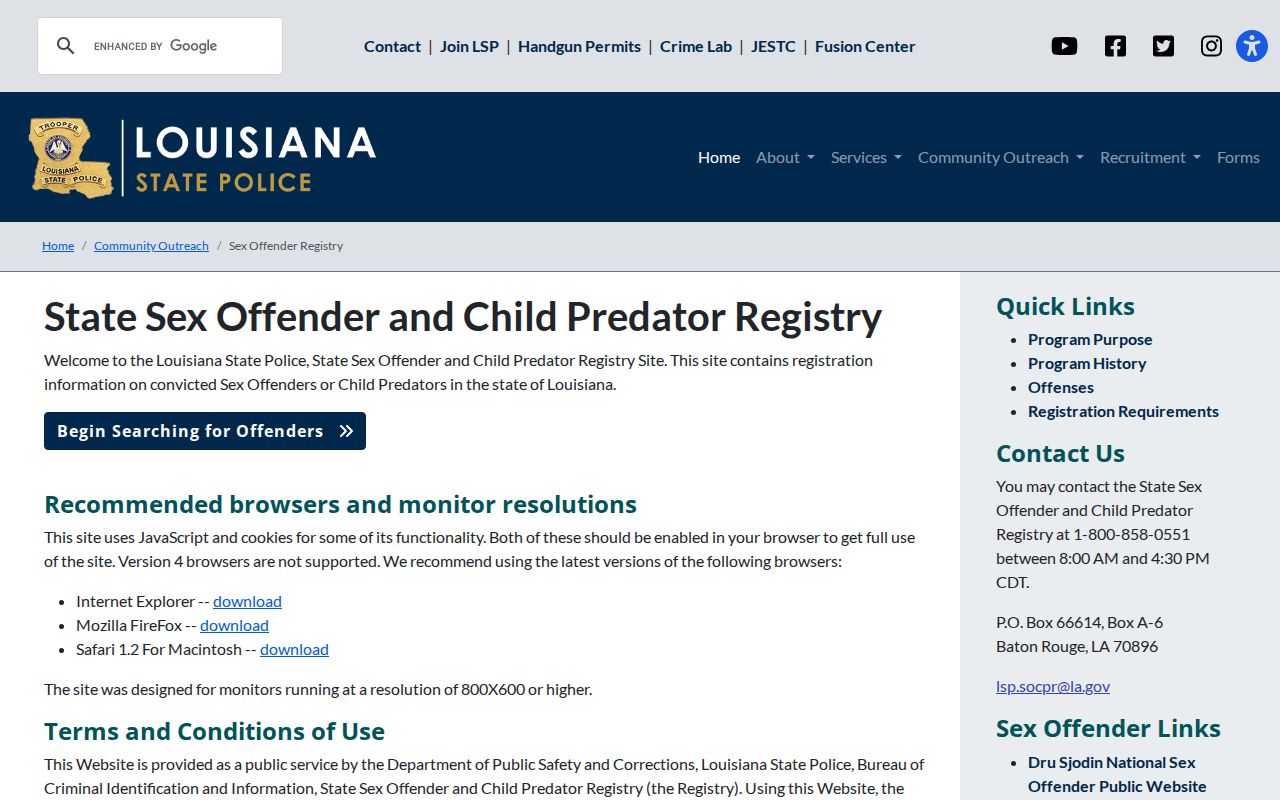
The live network should control because search fields, map behavior, and status information may change after an image was captured.
What a Registry Profile Shows
A typical profile combines identity, offense, address, and compliance data. Public display depends on Louisiana law and on the registering agency's record. Read the profile as a notification record, not as the complete court file. The charge description, conviction jurisdiction, and victim-age category may appear, but the certified judgment remains the stronger source for the exact disposition.
| Name & Aliases | Legal name plus reported alternate names |
|---|---|
| Photo & Physical Description | Photo, sex, race, age or displayed birth data, height, weight, hair, eyes, scars, marks, and tattoos |
| Registered Address | Residence or location information that law permits the portal to show |
| Offense & Statute | Offense, law, conviction jurisdiction, and authorized victim-age category |
| Level / Tier | Offense-based registration term rather than a simple public risk score |
| Registration Status | Registering agency, compliance status, and verification information |
Vehicle information may also appear. No one field proves that a person at a similar address is the registrant. Match the record as a whole and ask the official agency about a material error.
Calcasieu Border Registry Searches
Calcasieu Parish sits near Texas and sees interstate movement. A Louisiana-only query can therefore be too narrow for a cross-border safety question. The U.S. Department of Justice National Sex Offender Public Website, or NSOPW, searches participating jurisdictions through one interface. It offers a name path and geographic controls that include county, city or town, ZIP codes, states, territories, and Indian country.
NSOPW requires first and last name for its name route. Its ZIP route accepts up to five ZIP codes separated by spaces. Results still lead back to the source jurisdiction, whose profile and law govern the displayed entry. The official NSOPW search is useful when a person may have lived or registered outside Louisiana.
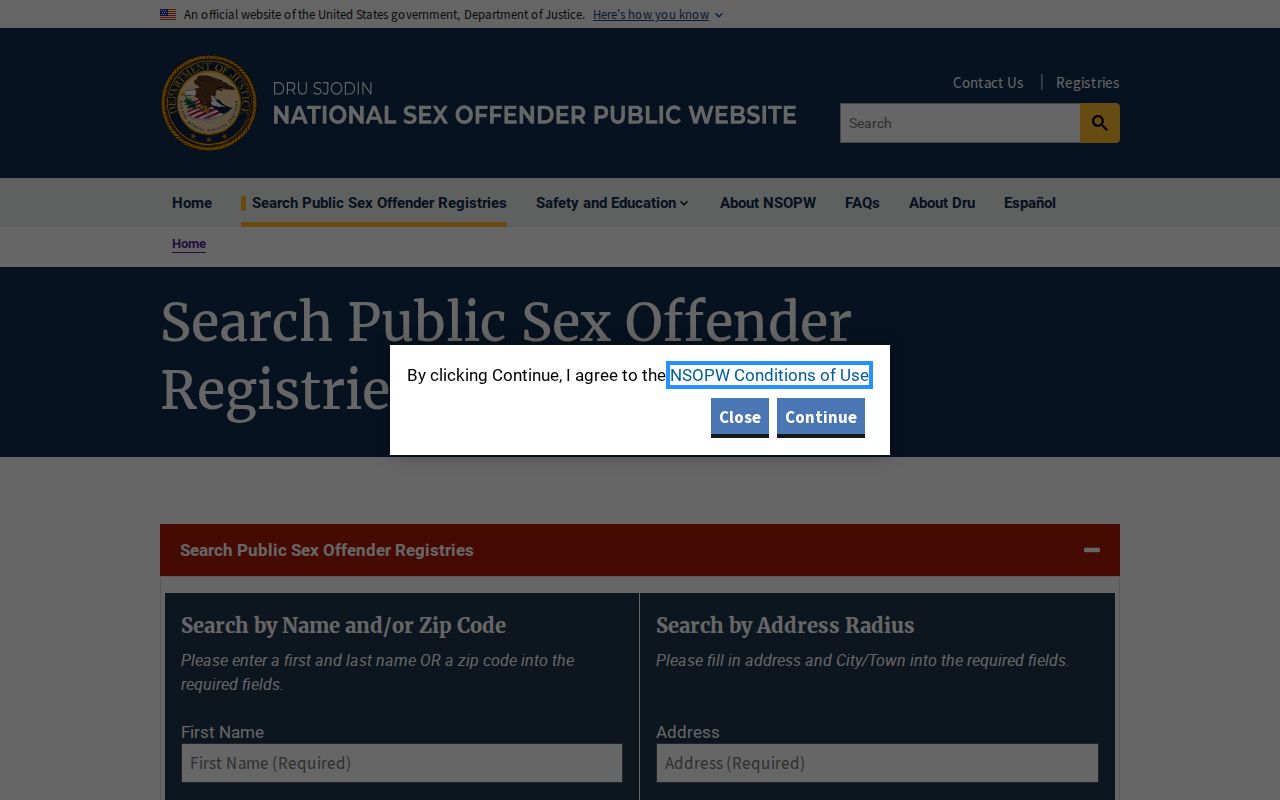
The national layer expands geography, while the Louisiana portal remains the direct source for a Calcasieu Parish profile.
Registration Requirements and Levels in Louisiana
Louisiana uses an offense and statute based scheme. It is not a three-color score of a person's current danger. R.S. 15:540 and following provisions control who must register, while definitions in R.S. 15:541 and the duration and frequency rules in R.S. 15:544 shape the duty. Common statutory periods are 15 years, 25 years, and life. Aggravated, repeat-offense, and child-predator categories may carry lifetime duties.
| Statutory Period | Duration | Verification |
|---|---|---|
| Limited term | Commonly 15 years | Periodic in-person verification set by classification |
| Extended term | Commonly 25 years | Periodic in-person verification set by classification |
| Lifetime duty | Life for qualifying categories | Periodic in-person verification set by classification |
The offense-specific statute must be checked before assigning a term or schedule. A public profile's status should not be converted into a homemade tier. Louisiana rules can also contain fact-specific residence and notice limits. Do not apply a broad distance claim without checking current R.S. 15:542, R.S. 15:542.1, and any valid local rule.
Calcasieu Registry Status and Risk
Compliant, noncompliant, and absconded are administrative status terms. They address registration duties and agency records. They do not measure the chance of a new offense. The map likewise shows reported registry locations, not a boundary between safe and unsafe places. Sound safety planning uses the registry as one source and avoids claims that the public fields cannot support.
Time also matters. A profile may reflect the last verified report, and an agency update may not post at once. Call LSP's registry line at 1-800-858-0551 between 8:00 a.m. and 4:30 p.m. Central for state-level help. Written correspondence goes to P.O. Box 66614, Box A-6, Baton Rouge, LA 70896. For a court-certified account of the conviction, contact the court that entered judgment rather than asking the registry to serve as the docket.
Calcasieu Address Alerts and Errors
Address alerts, where offered, are the least disruptive way to monitor a place. Save an address through the official registry network and follow its confirmation steps. An alert signals a change in portal data. It does not independently prove that a crime occurred, that a registrant is at a location at that moment, or that every nearby person is included.
If a profile appears inaccurate, record the profile identifier and the disputed field. Then contact the named registering agency or LSP. A disagreement about the conviction itself may require a certified disposition from the court. A disagreement about current registration data belongs with the agency that verifies it. This preserves a clear audit trail and reduces the risk of spreading an error.
Lawful Use and Community Notification
The registry exists for public notice, awareness, and safety planning. Use official alerts and report suspected noncompliance to CPSO or LSP. Do not visit a residence, threaten anyone, organize harassment, or publish unverified allegations. Registry information can be incomplete or out of date, and a profile should never be treated as permission to interfere with a registrant or the registrant's household.
Misuse is prohibited: Louisiana warns that using registry information to threaten, intimidate, or harass can be criminal. Registry data also may not be used to deny housing, work, or services except where law expressly permits.
For an urgent threat, call the proper emergency service. For suspected registration noncompliance in Calcasieu Parish, report facts to CPSO or LSP and let investigators verify them. The safer rule is simple: check, compare, document, and report. Do not confront.