
How to Check Criminal History in Sulphur
No one Sulphur database joins every local record. Sulphur Police Department is the source for reports created by its officers. Sulphur City Court preserves its city misdemeanor and traffic docket. CPSO records a parish jail booking, while the Calcasieu Clerk keeps felony and district-level prosecutions in the 14th JDC. BCII supplies the certified fingerprint-based route for a person's own statewide history.
- Identify whether Sulphur PD, CPSO, LSP, or another agency made the report.
- Use the official Sulphur public-records route for a city police report.
- Contact Sulphur City Court for a city misdemeanor or traffic docket.
- Check CPSO for current custody and the 14th JDC Clerk for district filing.
- Use LSP BCII Right to Review for your own statewide rap sheet.
Search spelling variants and an approximate date when the first query fails. Then call the responsible office. Residence in Sulphur does not prove that a Sulphur agency or court owns the record.
Identify the Sulphur Arresting Agency
The arresting or investigating agency is the first routing fact. A Sulphur resident stopped by LSP may have an LSP report, CPSO booking, and 14th JDC prosecution. Sulphur PD cannot release another agency's narrative. CPSO cannot recreate the city or state investigation simply because it handled jail intake.
Look at a citation, report number, booking entry, or court filing for the agency name. If none is available, give the date, location, and event type to the likely office and ask whether it is the custodian. This short step prevents duplicate requests and false conclusions from an empty city response.
The Sulphur Police Department
Sulphur PD creates city incident and arrest reports. Request those records through the official City of Sulphur public-records process. A useful request identifies the incident, date range, location, involved people, agency, and report number when known. State the desired record and format. Do not describe the request as a full background check because a police report covers one agency's event, not every court and repository entry.
The official City of Sulphur portal is the source for current police and public-request routing.
The live city page should be checked for current contact details before sending or delivering a request.
Sulphur Reports and Parish Bookings
A Sulphur police report describes the city officer's response and investigation. A CPSO booking record describes parish jail intake. It may include booking data, received charges, photograph, fingerprints, bond, and custody status. The two files can begin from the same arrest but serve different purposes and remain with different offices.
The free CPSO roster focuses on people in current custody. A person may vanish from that view after release even though the city report and later court file remain. For an older booking, make a specific CPSO records request. For the narrative, return to the arresting agency. For final legal action, locate the court.
Arrests and Bookings in Sulphur
After a Sulphur arrest enters parish custody, CPSO creates the intake record at its E. Broad campus in Lake Charles. Search the current roster by name and open the charge view. Read the listed charge as an intake allegation. Prosecutors may later decline it, amend it, or file a different count. Bond status and release data can also change quickly.
If the arrest produced a city misdemeanor or traffic case, Sulphur City Court is the next source. A felony filing goes to the 14th JDC. If no charge was filed, the police report and booking may be the main records that remain public, subject to restrictions and any later expungement order.
When a Sulphur Search Finds Nothing
The most important fallback is the parish clerk's own warning: it does not house Sulphur City Court records. A miss in the paid Online Index therefore says nothing conclusive about a city-level docket. Confirm the arresting agency, ask Sulphur PD for its report, contact City Court, check CPSO for current custody, and use 14th JDC only when a district prosecution was filed.
Other explanations include a spelling difference, reporting delay, release from custody, an archived file, a sealed or expunged record, and legally protected juvenile material. A no-result is a prompt to test the correct source, not proof that an event did not occur.
Sulphur Municipal Court Records
Sulphur City Court keeps its own city misdemeanor and traffic docket. It is not a branch of the Calcasieu Clerk's district criminal library. The research did not verify a public online municipal case interface, so contact the court through current official city channels. Supply the defendant name, date or approximate year, charge if known, and any case number.
| Court Name | Sulphur City Court |
|---|---|
| Case Types Heard | City misdemeanor, municipal, and traffic matters within its jurisdiction |
| Case Lookup Channel | City Court through official Sulphur contact routes; no verified public case portal |
| What the Docket Shows | Filed count, settings, pleas, court events, disposition, and sentence as applicable |
| Copies & Fees | Ask the court for the current copy and certification schedule |
Ask whether the response is an informational copy or a certified record. Certification may be useful when reconciling a BCII entry or documenting a disposition.
Sulphur City and District Cases
Venue follows jurisdiction and the charge filed. Sulphur City Court holds the lower-level city docket. The Fourteenth Judicial District Court hears felony and district-level matters, with its file kept by the Calcasieu Clerk in Lake Charles. Louisiana does not use one universal class chart for all felonies, so read the charged statute and the actual court filing.
A case can also look different from the booking. The court docket records the filed count, arraignment, motions, plea or trial, judgment, and sentence. The CPSO entry records custody. Searchers who need the full district process can follow the county criminal court case records route.
Where Sulphur Records End Up
Local records do not all flow into the parish clerk. A Sulphur City Court file remains with that court. A district prosecution goes to the Calcasieu Clerk. Reported arrests and dispositions may reach Louisiana State Police BCII as fingerprint-linked history, but reporting can lag and a missing disposition can leave an incomplete cycle.
Record flow: Sulphur PD › Sulphur City Court or Calcasieu Parish Courts › Louisiana State Police BCII
For a recent incident, start with SPD and CPSO. For the legal outcome, ask the filing court or seek the DA's free disposition letter. For a person's own statewide review, use LSP's certified Right to Review through LAPS.
Sulphur Disposition Letters
The Calcasieu District Attorney offers free disposition letters. This is a useful bridge when an arrest label, booking charge, court outcome, and BCII cycle do not line up. Give the office enough identifying and case detail to find the prosecution. The letter does not replace every document in a certified court packet, but it can state how the case ended.
The DA also publishes official news about selected prosecutions. Those posts can identify an offense, verdict, judge, and sentencing event, but they are not the complete docket and should not be used as one. Use the court file for the procedural record.
The official DA news page illustrates the difference between a public summary and a case file.
Any selected announcement should be verified against the court that holds the underlying prosecution.
Sulphur Expungement Court Choice
Louisiana expungement removes qualifying material from public access but does not destroy the record. File in the court that possesses the record. A Sulphur City Court matter cannot be cleared merely by filing papers in the 14th JDC, and a district prosecution requires the district route. Statutory forms and service on the required custodians are essential.
After an order, allow processing time and check each separate source. The court, arresting agency, sheriff, and BCII may hold distinct parts of the record. If one public entry remains, send the certified order to that custodian rather than assuming another office can edit it.
Sulphur Industrial Corridor Records
Sulphur's industrial and I-10 setting increases the chance that an event involves more than SPD. CPSO, LSP, or another agency may investigate a crash, stop, warrant, or cross-jurisdiction event. The city where the event occurred does not always identify the report custodian. Check the agency name before requesting.
A statewide network entry or parish booking still does not transfer the original report. The official source shown below supports Sulphur-specific statutory context.
The Louisiana Legislature source provides the governing law captured for the Sulphur page.
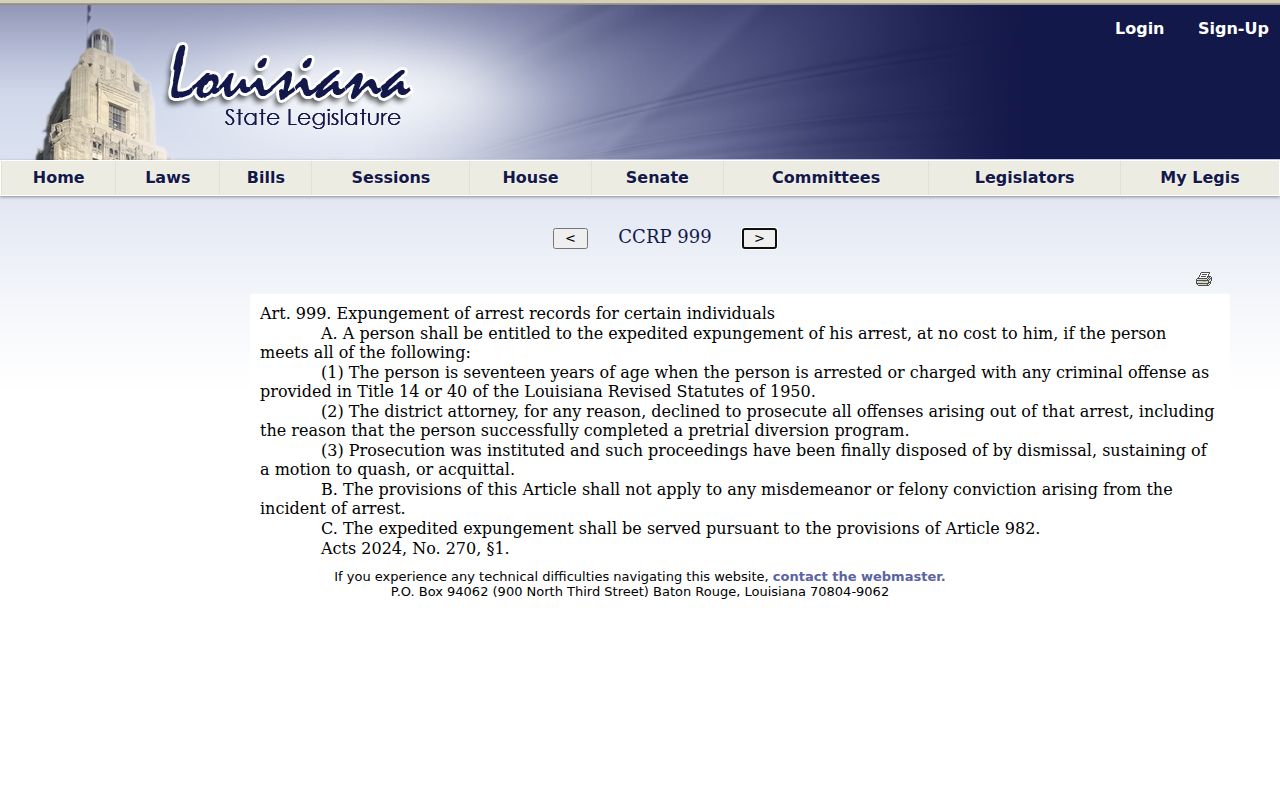
Apply the current statutory text to the specific record and agency rather than assuming one rule opens every file.
Sulphur Statewide Self-Review
A Sulphur police or court search is not a statewide criminal history. Louisiana State Police BCII provides a certified Right to Review for any person seeking their own fingerprint-linked record under R.S. 15:588. The person schedules through the Louisiana Applicant Processing System, attends an IdentoGO or IDEMIA enrollment site, supplies fingerprints and identity details, pays the current fee, and selects an available mailed or electronic delivery route.
The fingerprint match reduces the ambiguity of names. The result can still contain an arrest cycle with no linked disposition if reporting was late or incomplete. Compare a disputed entry with a certified judgment from Sulphur City Court or the 14th JDC and, when useful, the DA's free disposition letter. Follow BCII's challenge instructions rather than asking SPD to edit the statewide repository. SPD can address its own report; the court can certify its own outcome.
Sulphur Warrant Record Routing
No verified comprehensive CPSO warrant portal covers every Sulphur matter. The current inmate roster is not a warrant search. A Sulphur City Court bench warrant belongs with that court, while a district warrant or attachment belongs with the 14th JDC. An investigative warrant may remain sealed or restricted for safety and case reasons.
Use the issuing court's official contact and treat a phone answer as time-sensitive. If the purpose is to resolve a warrant, work through the court or counsel and obtain written clearance. A cleared warrant may take time to disappear from every operating system. Crime Stoppers and tip channels are for reporting information, not for confirming a person's own status.
Public Access Rules for Sulphur Records
The Louisiana Public Records Law supports inspection and copying of nonrestricted city records. It also permits withholding or redaction where an exception applies. Police may protect active investigative details, confidential sources, juvenile files, victim or minor identities, medical information, security data, and personal identifiers. Courts can restrict sealed and expunged material.
Key Statutes:
Louisiana Public Records Law - Title 44 sets access rights and custodian duties, subject to exceptions.
Louisiana R.S. 44:3 - designated investigative and prosecutorial records may be withheld.
Louisiana C.Cr.P. art. 971 - expungement makes qualifying records confidential to the public without destruction.
A focused request helps Sulphur staff find and separate releasable material. If the city is not the custodian, ask which agency or court holds the record and continue there.